

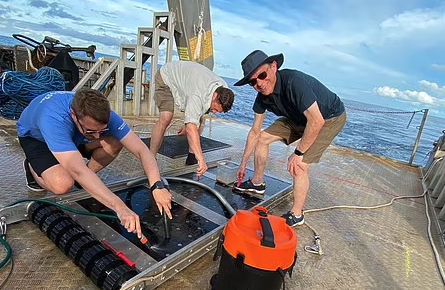
In an incredible first in history, scientists claim to have recovered material from outside our solar system for the first time ever.
Retrieved from the Pacific Ocean in June, the mysterious fragments have left alien-hunting Harvard physicist Professor Avi Loeb questioning whether or not these tiny metallic spheres could have been fragments of an extraterrestrial craft.
The expedition, conducted by Professor Loeb’s team, obtained around 700 of these spheres from the same place where the interstellar object IM1 crashed off the coast of Papua New Guinea in 2014. After analyzing 57 of these fragments, the team determined that the composition did not match any natural or manufactured alloys from either Earth or other bodies in our solar system.
These compositions include Beryllium, lanthanum, uranium, low content of elements that bind to iron, and an “overabundance of heavy elements,” which Professor Loeb theorized could have been ejected from supernovae or neutron star mergers.
However, he does not believe these to be the only possibilities, as the element pattern suggests the fragments originated from Asymptotic Giant Branch (AGB) stars, which have been found to be the final stage of evolution for low- and intermediate-mass stars.
For years, Professor Loeb has argued that Earth may have been visited by extraterrestrial technology. After the discovery of Oumuamua in 2017, he suggested that more interstellar objects have likely passed by us, leading to the impetus of the expedition of this June.
While the team’s findings do not yet answer whether the spheres are artificial or natural in origin, it is certainly an exciting discovery full of mystery and potential. Professor Loeb aims to uncover the puzzle further with his future research plans.
Many of his fellow researchers have expressed criticism and even ridicule of Professor Loeb’s endeavors. Some have even suggested that his claims are ‘polluting good science’ and “sucking all the oxygen out of the room.”
Yet despite the negative comments, Professor Loeb seems to remain firmly committed to his research and, as the study’s lead scientist, he is determined to uncover the enigma behind the fragments retrieved from the Pacific.
It will be interesting to see the developments that arise from Professor Loeb’s study and to learn if the analysis of the spherules will provide scientific evidence of extraterrestrial technology and life beyond Earth.

