

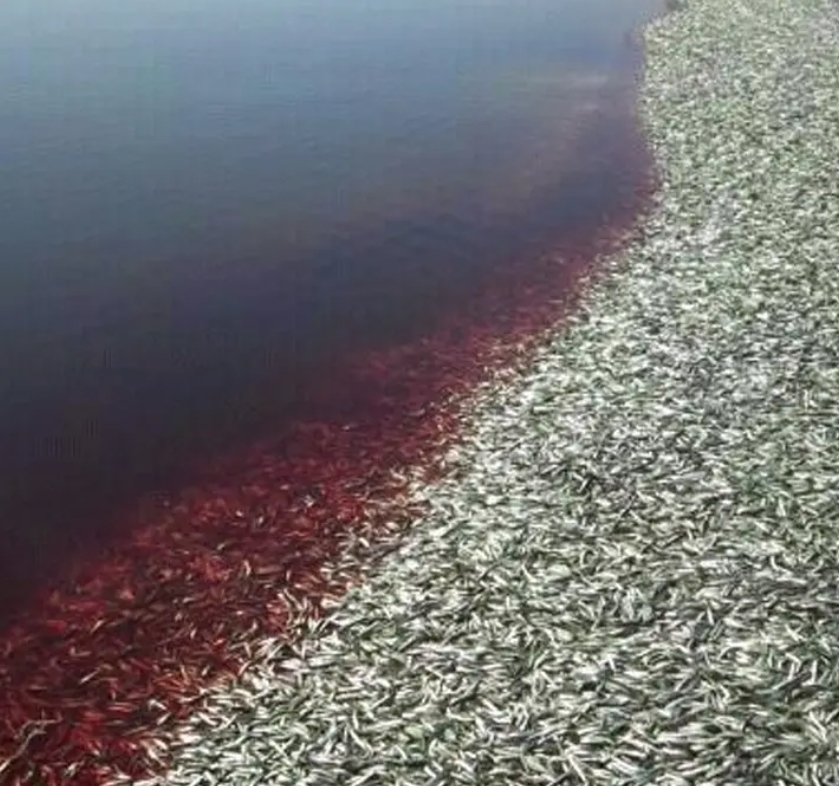
Hundreds of tonnes of fish have mysteriously washed ashore in Japan, leaving officials scrambling to determine the cause. The strange phenomenon has occurred in two separate locations in recent days, raising concerns about the marine ecosystem and sparking conspiracy theories about the ongoing effects of the Fukushima nuclear disaster.
In the fishing port of Hakodate in Hokkaido, an estimated 1,200 tonnes of sardines and mackerel were found floating on the surface of the sea earlier this month. The blanket of silver fish stretched for more than a kilometer, with officials struggling to explain the sudden mass mortality.
More recently, in Nakiri, a town on the Pacific coast hundreds of miles south of Hokkaido, officials were confronted with 30 to 40 tonnes of Japanese-scaled sardines, or sappa, washing ashore. This is a significant amount, considering that these fish had only been observed in the area in the last year.
Local fishers quickly rushed to collect the fish, fearing that their decomposing carcasses would lower the oxygen content of the water and harm the marine environment. “I’ve never seen anything like this before,” one fisher, who has worked in the area for 25 years, told the Mainichi Shimbun. “It makes me wonder if the marine ecosystem is changing.”
Experts have speculated that the cause of the mass mortality events could be exhaustion from being chased by predatory fish or a sudden drop in water temperature, causing shock. However, no definitive answer has been found yet. “The cause is unknown at the moment,” Mikine Fujiwara, a local fisheries official, said to the newspaper. “We plan to sample the seawater at the site and examine it to uncover the cause.”
In response to the strange occurrence, the Japanese government has rejected a report by the British newspaper The Daily Mail that linked the incident to the ongoing discharge of treated water from the Fukushima Daiichi nuclear power plant. The release of the water, which contains small amounts of the radioactive isotope tritium, was approved by the International Atomic Energy Agency which deemed it to have “a negligible radiological impact on people and the environment.”
China, who opposed the release and imposed a ban on Japanese seafood, has been accused of hypocrisy as their own nuclear plants routinely pump wastewater with higher levels of tritium. Despite this, many Japanese fisheries are concerned about the negative impact of the discharge on their seafood reputation.
Officials from the Japanese fisheries agency have urged caution against “unsubstantiated information” and emphasized that there have been “no abnormalities” found in the results of water-monitoring surveys around the Fukushima plant.
Images of the stranded fish have circulated widely on social media, with conspiracy theories linking them to the nuclear disaster. Town officials in Hakodate have warned against consuming the fish, and a fisheries researcher, Takashi Fujioka, said, “We don’t recommend eating them as we don’t know the circumstances under which these fish were washed ashore.” The mysterious mass mortality event continues to baffle officials, who are determined to uncover the cause and protect the marine ecosystem.

